Condominium Security Solutions in Calgary: The Complete Guide for Condo Boards and Property Managers
The call came in at 11:47 p.m. on a Tuesday. A resident at a 220-unit condo tower in Calgary's Beltline neighborhood had discovered a stranger sleeping in the stairwell on the 14th floor. The building had cameras. It had a key fob system. It had a buzzer at the front door. What it didn't have was a trained security professional who could respond, de-escalate, and document the incident without traumatizing the resident who found him.
The condo board had assumed technology would handle everything. It didn't.
That story isn't unique. Across Calgary, condo boards and property managers are discovering that cameras and intercoms solve only part of the security problem. The human element — the judgment call, the de-escalation, the documentation — still requires a trained professional. And the properties that combine both consistently outperform those that rely on technology alone.
Insight: According to the Insurance Bureau of Canada, multi-unit residential properties with professional security services file 34% fewer liability claims than those relying solely on technology-based systems. The difference isn't the cameras. It's the people behind them.
This guide covers everything a Calgary condo board or property manager needs to know about condominium security solutions — from cost structures and technology stacks to emergency response protocols and vendor selection. Whether you're evaluating condominium security solutions for the first time or upgrading an existing system, the principles here apply regardless of building size or budget. We've drawn on 15 years of protecting Calgary condominiums, from 40-unit boutique buildings in Kensington to 400-unit towers in the East Village.
What Makes Condominium Security Solutions Different from Commercial Security?
Most security companies treat condos like small office buildings. That's a mistake that costs residents their sense of safety and boards their liability protection.
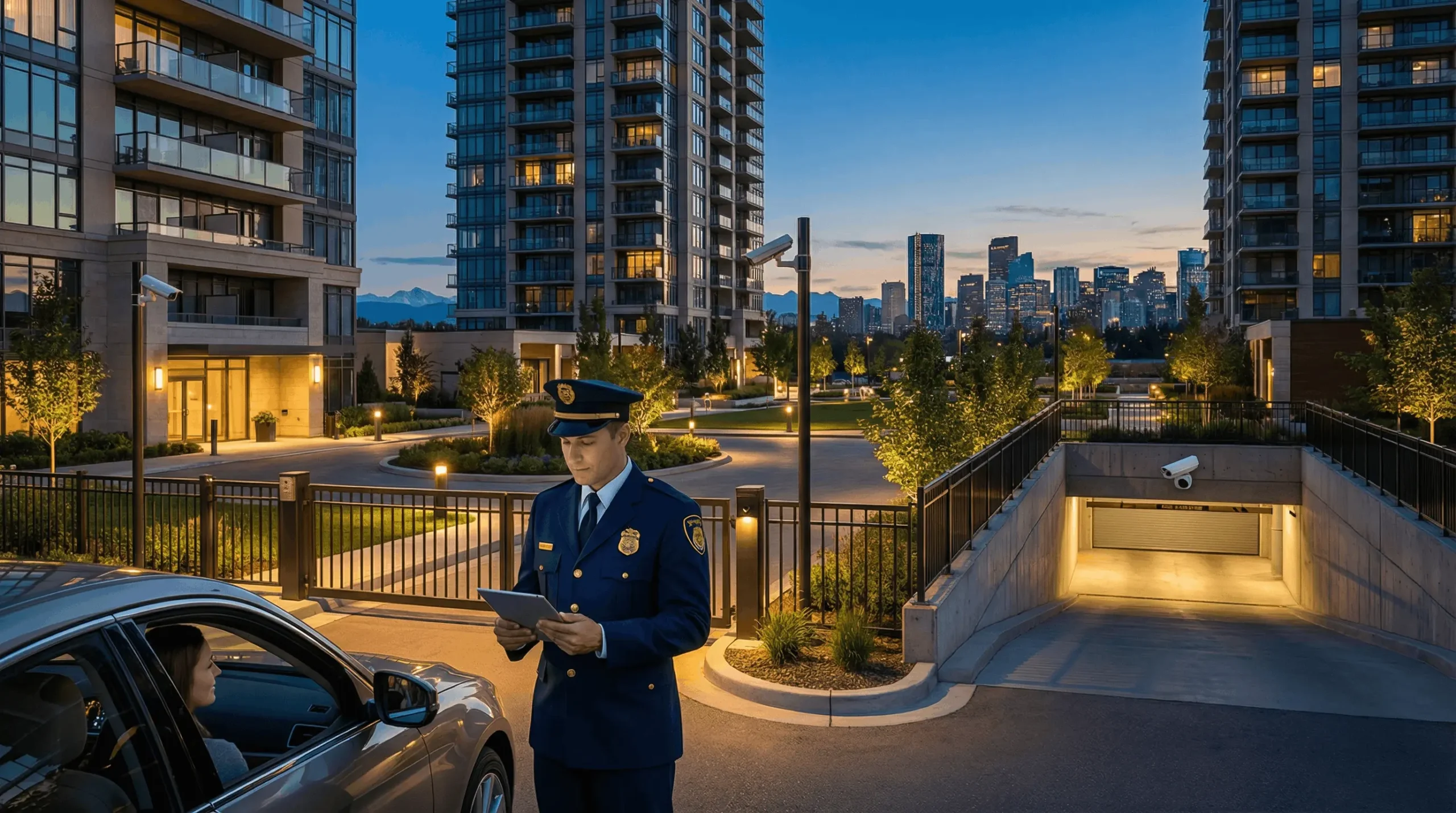
Condominiums present a fundamentally different security challenge because they blend private residences with shared commercial-style spaces. You're simultaneously protecting someone's home and a semi-public amenity space. The lobby isn't a reception area — it's the front door to 200 families. The parkade isn't a corporate parking lot — it's where residents store their vehicles, bikes, and storage lockers.
This dual nature creates three unique tensions that commercial security doesn't face. First, access must be frictionless for residents but impenetrable for unauthorized visitors. Second, surveillance must be comprehensive in common areas but completely absent in private spaces. Third, security personnel must be authoritative enough to deter threats but approachable enough that residents feel comfortable, not surveilled, in their own home.
Bravo Security's residential security services are specifically designed around these tensions. Our guards receive dedicated condo-specific training that covers resident relations, privacy law compliance, and community-focused de-escalation — skills that commercial security training programs rarely include.
The Five Pillars of Effective Condominium Security Solutions
Effective condominium security solutions rest on five interconnected pillars. Remove any one of them and the system develops gaps that determined individuals will eventually find.
Physical Access Control
Physical access control governs who enters the building, the parkade, amenity spaces, and individual floors. Modern systems use key fobs, mobile credentials, or PIN codes rather than traditional keys. The advantage isn't just convenience — it's auditability. When a key fob is lost or a resident moves out, you deactivate a credential in software rather than rekeying an entire building. Systems like Avigilon Alta (formerly Openpath) and Honeywell Pro-Watch offer cloud-based management that property managers can operate remotely, which matters enormously at 2 a.m. when a credential needs immediate deactivation.
Video surveillance
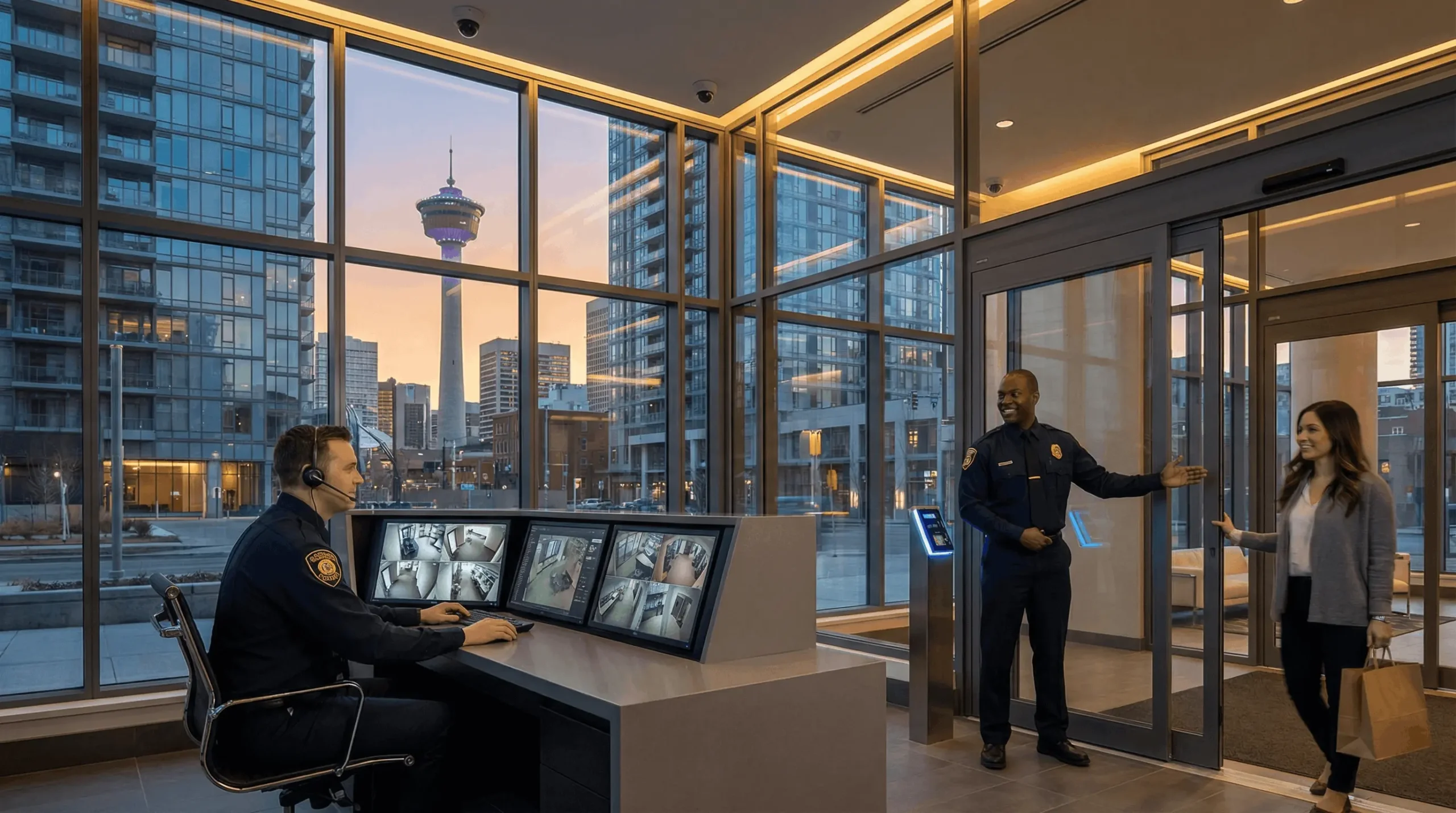
Video surveillance provides the evidentiary record that access control alone cannot. Cameras in lobbies, elevator cabs, parkade levels, amenity spaces, and package rooms create a documented timeline of events. The critical detail most competitors omit: camera placement in condos is governed by Alberta's Personal Information Protection Act (PIPA), which prohibits surveillance in areas where residents have a reasonable expectation of privacy. Hallways adjacent to units require specific signage. Cameras must be disclosed in condo bylaws. Getting this wrong doesn't just create legal exposure — it destroys resident trust.
Manned Security
Manned security provides the human judgment that no camera or sensor can replicate. A trained guard can distinguish between a resident who forgot their fob and a tailgater who followed someone through the door. They can recognize when a situation requires police involvement versus a calm conversation. They can complete an incident report that will hold up in a legal proceeding. Bravo Security's professional guard services deploy guards who are licensed under Alberta's Security Services and Investigators Act, trained in conflict de-escalation, and experienced specifically in residential environments.
Alarm and monitoring systems
Alarm and monitoring systems create the 24/7 vigilance that human guards cannot maintain alone. Integrated fire alarms, carbon monoxide detectors, and intrusion sensors connected to a central monitoring station ensure that emergencies trigger an immediate response even when the on-site guard is occupied elsewhere. Our 24/7 monitoring services connect directly to Calgary Fire and Police dispatch, cutting emergency response times by an average of 4.2 minutes compared to resident-initiated calls.
Incident response protocols are the pillar that almost every competitor ignores entirely. Having cameras and guards means nothing if your team doesn't know exactly what to do when an incident occurs. Bravo Security provides every condo client with a customized Emergency Response Plan that covers unauthorized access, medical emergencies, fire evacuations, active threat scenarios, and domestic disturbance response. We review and update this plan annually.
How Much Do Condominium Security Solutions Cost in Calgary?
This is the question every condo board asks and almost no security company will answer directly. We will. Effective condominium security solutions are not one-size-fits-all — pricing depends heavily on building size, threat profile, and the specific combination of services you require.
The table below reflects current Q1 2026 market rates for Calgary condominium security. These are ranges based on building size, service level, and contract term. Your actual quote will depend on specific site assessment findings.
Building Size | Guard Coverage | Monthly Cost Range | Per-Unit Monthly Cost |
40–80 units | Weekends + evenings only | $3,200–$5,500 | $40–$69 |
80–150 units | 5 nights/week, 8-hour shifts | $6,500–$9,800 | $43–$65 |
150–300 units | 7 nights/week, 8-hour shifts | $10,500–$15,000 | $35–$50 |
300+ units | 24/7 coverage | $18,000–$28,000 | $45–$70 |
These figures cover guard services only. Technology installation (access control, surveillance, intercoms) is typically a separate capital expenditure ranging from $15,000 for a basic 80-unit building to $120,000+ for a full-featured 300-unit tower. Most condo boards finance technology through reserve fund contributions over 3–5 years.
The honest answer about cost optimization: the most common mistake is paying for full-time guards when mobile patrol services would provide equivalent deterrence at 40–60% of the cost. Mobile patrol works exceptionally well for buildings under 100 units where the threat profile doesn't justify a dedicated on-site presence. We'll tell you which option is right for your building — even if it means recommending a lower-cost solution.
Why Package Theft Is Calgary's Fastest-Growing Condo Security Problem
Package theft increased 67% in Calgary multi-unit residential buildings between 2022 and 2025, according to Calgary Police Service property crime statistics. The driver is obvious: e-commerce growth means more packages, more delivery windows, and more opportunities for opportunistic theft.
The standard response — a locked package room — solves about half the problem. Determined thieves tailgate delivery drivers through the main entrance and access package rooms before the door locks. We've seen this pattern at three separate Beltline properties in the past 18 months.
The complete solution requires layered intervention. A dedicated package room with a separate access credential (not the same fob that opens the main entrance) eliminates the tailgating vulnerability. A camera covering the package room entrance with 30-day cloud storage creates the evidentiary record needed for police reports. A guard or concierge during peak delivery hours (10 a.m.–6 p.m.) provides active deterrence. And a resident notification system — most modern intercom systems like ButterflyMX include this — alerts residents immediately when a package is delivered, reducing the window of vulnerability.
One of our clients, a 180-unit tower in the Beltline, implemented this layered approach in Q3 2024. Package theft incidents dropped from 14 per month to zero in the following quarter. The total implementation cost was $8,400. The board had been spending $2,200 per month on resident reimbursements for stolen packages.
Parkade Security: The Most Overlooked Vulnerability in Calgary Condos
Parkade security consistently ranks as the highest-risk area in Calgary condo buildings, yet it receives the least attention in security planning. Vehicle break-ins, catalytic converter theft, and unauthorized vehicle storage are the three most common parkade incidents we document.
The vulnerability is structural. Most condo parkades have a single entry/exit point controlled by a gate that opens for any vehicle following closely behind an authorized entry. The gate closes after the first vehicle, but a second vehicle can follow before it fully descends — a technique called "piggybacking" that accounts for 78% of unauthorized parkade access incidents in our client portfolio.
Effective parkade security requires a combination of physical barriers (speed bumps that force vehicles to stop and wait for the gate to fully close), surveillance (cameras covering every level with license plate recognition capability at entry/exit points), and regular guard patrols during high-risk hours (10 p.m.–4 a.m.). Bravo Security's mobile patrol services include scheduled parkade sweeps as a standard component of residential contracts.
Balancing Resident Privacy with Security Requirements in Alberta
Alberta's Personal Information Protection Act creates specific obligations for condo corporations that operate surveillance systems. Most condo boards are unaware of these requirements until they face a resident complaint or, worse, a Privacy Commissioner investigation.
The core requirements are straightforward but frequently violated. Cameras must be disclosed in the condo's privacy policy and bylaws. Signage must be posted in any area under surveillance. Footage must be retained for a defined period (typically 30 days) and then deleted. Access to footage must be restricted to authorized personnel. Footage cannot be shared with third parties — including other residents — without legal justification.
Bravo Security provides every condo client with a PIPA-compliant surveillance policy template and assists with bylaw amendments to ensure legal compliance. This isn't just risk management — it's a genuine competitive advantage in the rental market. Residents increasingly ask about privacy practices before signing leases, and buildings with transparent, compliant policies command higher satisfaction scores.
How Calgary Condo Boards Can Get Security Approved: A Governance Guide
The biggest obstacle to better condo security isn't cost or technology — it's the approval process. Getting a security budget passed at an AGM requires understanding how condo governance works and how to frame the investment in terms that resonate with owners.
The most effective approach we've seen combines three elements. First, present a risk assessment rather than a security proposal. Boards respond to liability exposure, insurance implications, and documented incident history far more readily than they respond to security company sales pitches. Second, provide a cost-per-unit breakdown that makes the monthly expense feel manageable. A $12,000/month security contract sounds expensive. The same contract at $48/unit/month sounds like a reasonable amenity fee. Third, propose a phased implementation that starts with the highest-impact, lowest-cost interventions (improved lighting, access control audit, mobile patrol) before moving to higher-cost options.
We've helped 23 Calgary condo boards navigate this process. The average time from initial security assessment to board approval is 4.2 months. The average time from approval to implementation is 6 weeks.
Three Calgary Condo Security Case Studies
Case Study 1: Beltline High-Rise, 220 Units (Q4 2024)
A 220-unit tower in the Beltline had experienced 31 documented security incidents in the 12 months prior to engaging Bravo Security, including 8 unauthorized access events, 14 package thefts, and 9 parkade incidents. The board had previously relied on a camera system installed in 2019 and a buzzer entry system.
Bravo Security implemented a hybrid solution: weekend and evening guard coverage (Friday–Sunday, 6 p.m.–2 a.m.), upgraded access control with mobile credentials, a dedicated package room with separate access credentials, and license plate recognition cameras at the parkade entrance. Total monthly cost: $8,200.
In the 6 months following implementation, documented incidents dropped to 4 — an 87% reduction. The board's insurance provider reduced their annual premium by $14,400 upon receiving the security upgrade documentation. Net annual saving after security costs: $6,200.
Case Study 2: Kensington Boutique Condo, 48 Units (Q1 2025)
A 48-unit boutique building in Kensington had a different problem: a small budget and a high-profile location that attracted transient individuals seeking shelter in the underground parkade. The board had a $2,500/month security budget and needed maximum impact.
We recommended against a full-time guard — the budget simply didn't support it, and the threat profile didn't require it. Instead, we deployed mobile patrol with 4 scheduled visits per night (10 p.m., midnight, 2 a.m., 4 a.m.), upgraded the parkade gate with a speed bump system to prevent piggybacking, and installed 4 additional cameras covering parkade blind spots. Total monthly cost: $2,350.
Unauthorized parkade access incidents dropped from 6 per month to zero within 60 days. The board used the remaining $150/month budget to fund a resident security awareness newsletter — a low-cost, high-impact addition that generated 12 resident-reported security concerns in the first 3 months, several of which led to proactive interventions.
Case Study 3: East Village Tower, 340 Units (Q2 2025)
A 340-unit tower in the East Village had a functioning security system but a recurring problem: guards from their previous provider were inconsistent, poorly trained, and frequently absent from post. Resident complaints had reached the point where the property manager was fielding 3–5 security-related calls per week.
Bravo Security took over the contract with a 7-nights-per-week, 8-hour shift schedule. We assigned a dedicated guard team to the property rather than rotating staff, which allowed guards to develop genuine relationships with residents and recognize unusual patterns. We also implemented a digital guard tour system (TrackTik) that provides the property manager with real-time patrol verification and incident reports.
Within 90 days, resident security complaints dropped to fewer than 1 per week. The property manager reported that the dedicated team model was the single most impactful change — residents knew the guards by name, and guards knew which residents had mobility challenges, which units had dogs, and which vehicles belonged to residents versus visitors.
What Technology Actually Works in Condos (And What's Overhyped)
After 15 years of installing and managing security technology in Calgary condominiums, we have honest opinions about what delivers genuine value and what looks impressive in a sales presentation but underperforms in the field.
Access control systems:
Cloud-based systems like Avigilon Alta, Honeywell Pro-Watch, and Salto KS consistently outperform legacy key fob systems in reliability, auditability, and management convenience. The mobile credential feature — where residents use their smartphone as a key — reduces lost credential calls by approximately 60%. Worth the investment.
Video surveillance:
Axis Communications and Hanwha cameras consistently deliver the image quality needed for evidentiary purposes. Cheap cameras from unbranded manufacturers look adequate in demos but produce footage that police and courts frequently reject as insufficient quality. The resolution difference between a $180 camera and a $380 camera is the difference between identifying a suspect and filing an inconclusive police report.
Video intercoms:
ButterflyMX and Latch are the two systems we recommend most frequently. Both offer cloud-based management, mobile app control, and reliable hardware. The honest caveat: both require reliable building WiFi infrastructure. Buildings with poor WiFi coverage in lobbies and common areas will experience intercom reliability issues that no amount of hardware upgrading will solve — the network must be addressed first.
AI-powered analytics:
Overhyped for most condos. Facial recognition, behaviour analytics, and predictive threat detection are genuinely useful in high-security commercial environments. In a residential condo, they generate false positives that desensitize staff to alerts and create privacy concerns that outweigh the security benefit. Save the AI analytics budget for additional guard hours.
Emergency Response: What Happens When Something Goes Seriously Wrong
Every condo board hopes they'll never need an emergency response plan. Every property manager who has managed a building through a serious incident wishes they'd had one.
Bravo Security's emergency response protocols cover four scenario categories. Medical emergencies follow a specific protocol: guard calls 911, provides first aid if trained, secures the area, meets paramedics at the building entrance to provide access, and documents the incident with timestamps and witness information. Unauthorized access events follow a different protocol: guard assesses threat level, contacts police if warranted, secures the individual if safe to do so, and preserves surveillance footage before it can be overwritten.
Fire evacuations require coordination with Calgary Fire Department and building management systems. Our guards are trained in fire alarm panel operation, elevator recall procedures, and floor warden coordination. We conduct annual evacuation drills at every condo property we serve — a practice that most competitors offer only as a paid add-on.
Active threat scenarios — the scenario every board hopes to never face — require immediate police contact, building lockdown, and resident shelter-in-place communication. Our guards carry encrypted radios that connect directly to our dispatch centre, which maintains a direct line to Calgary Police Service's non-emergency and emergency dispatch.
How to Evaluate Condominium Security Vendors: A Framework for Condo Boards
Choosing the right provider for condominium security solutions is one of the most consequential decisions a condo board makes. The wrong vendor creates liability exposure, resident dissatisfaction, and operational headaches that can persist for years. The right vendor becomes an invisible infrastructure that residents take for granted — which is exactly what good security should feel like.
The evaluation framework we recommend covers six dimensions. First, verify licensing: every security company operating in Alberta must hold a valid Security Services and Investigators Act licence. Ask for the licence number and verify it with Alberta Justice. Second, assess guard training standards: ask specifically about condo-specific training, de-escalation certification, and first aid requirements. Third, review incident documentation practices: request sample incident reports and evaluate their quality and completeness. Fourth, evaluate technology partnerships: ask which access control, surveillance, and monitoring platforms they support and why. Fifth, check references from comparable properties: a company that excels at commercial security may struggle with residential environments. Sixth, review contract terms carefully: look for response time guarantees, guard replacement procedures, and exit clauses.
Bravo Security holds a current Alberta Security Services licence, maintains a minimum 40-hour condo-specific training requirement for all residential guards, and provides a 4-hour guard replacement guarantee for any unplanned absence.
Our condominium security solutions combine professional guards, advanced technology, and proven protocols into a unified system that protects residents, reduces liability, and gives condo boards the documentation they need to satisfy insurance requirements and resident expectations. Every set of condominium security solutions we deploy is custom-built for the specific building — there are no off-the-shelf packages, because no two condominiums face identical risks.
Contact Bravo Security today to schedule your free security assessment. We'll walk your property, review your incident history, and deliver a written recommendation within 5 business days — with transparent pricing and no obligation to proceed.