Hotel Security Services in Calgary: The Complete Guide to Protecting Guests, Staff, and Revenue
A downtown Calgary hotel lost $340,000 in a single quarter. Not from a fire. Not from a flood. From three separate incidents that a proper hotel security program would have prevented entirely: a guest assault in a poorly monitored stairwell, a series of room thefts that exposed the property to civil litigation, and a conference event that spiraled into a public disturbance requiring police intervention. The general manager told us afterward: "We thought cameras were enough. We were wrong."
Hospitality security is not a line item to minimize. It is the invisible infrastructure that determines whether guests return, whether staff feel safe, and whether your property survives the incidents that every hotel eventually faces. This guide covers everything Calgary hoteliers need to know — from the specific threats your property faces to the integrated protection model that actually works, with real numbers and real outcomes.
What Does Professional Hotel Security Actually Involve?
Protecting a hotel property means deploying a coordinated system of personnel, technology, protocols, and training that safeguards guests, employees, and assets from theft, assault, vandalism, unauthorized access, and emergency situations. It is not simply hiring a guard to stand at the front door.
Effective property protection operates across five distinct layers: physical access control, personnel deployment, surveillance monitoring, incident response, and guest communication. When all five layers function together, incidents are prevented rather than merely responded to. When any layer fails, the consequences can be severe — financially, legally, and reputationally.
Calgary's hotel market presents unique protection challenges. With over 50 hotels and 8,000+ rooms serving a mix of business travelers, tourists, and Stampede visitors, the city's hospitality sector experiences security threats that are both predictable and preventable. Transient guest populations, high-value conference events, and seasonal demand spikes all create windows of vulnerability that professional hospitality protection is specifically designed to close.
Why Most Hotels Are Under-Protected (And Don't Know It)
Here is the uncomfortable truth: most hotels believe they have adequate security until an incident proves otherwise. The belief that cameras and a single overnight guard constitute a comprehensive protection program is one of the most expensive misconceptions in the hospitality industry.
Cameras record. They do not prevent. A camera captures the theft of a guest's laptop from a hotel corridor. It does not stop it. A camera documents the assault in a parking garage. It does not intervene. The footage becomes evidence after the damage is done — to the guest, to the property, and to the hotel's reputation on TripAdvisor.
The gap between perceived security and actual security is where most hotel incidents occur. Bravo Security has assessed dozens of Calgary properties and found the same pattern repeatedly: cameras in public areas, minimal coverage of back-of-house zones, no formal incident response protocol, and on-site staff who have received no de-escalation training. This is not a criticism — it reflects the industry standard. Our job is to raise it.
The Five Property Zones That Require Dedicated Security Protocols
A professional approach treats a property not as a single location but as five distinct security zones, each with its own threat profile and required response.
Zone 1: The Lobby and Front Entrance.
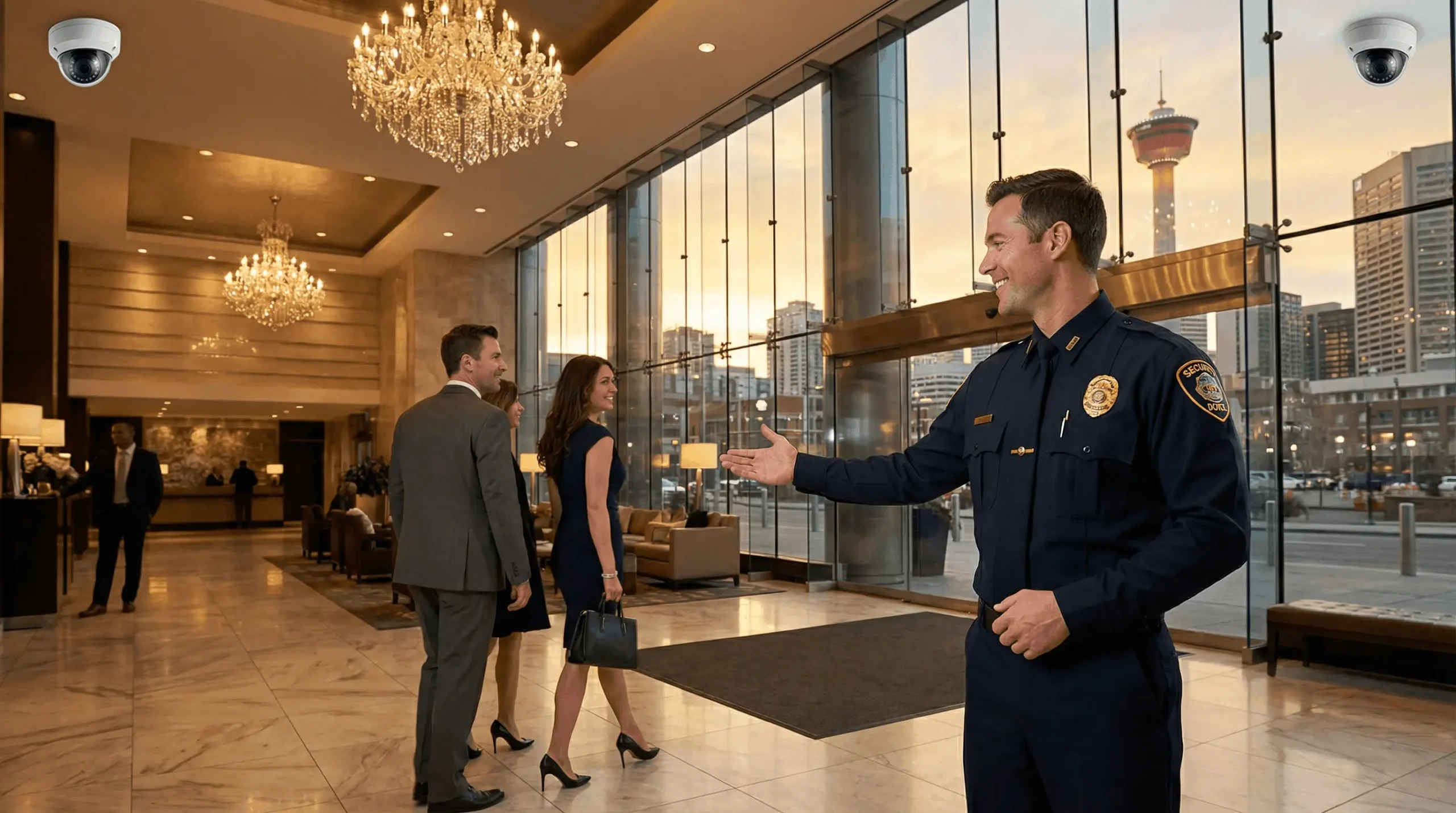
The lobby is simultaneously the most visible and most vulnerable area of any hotel. It is where unauthorized individuals attempt to access the property, where intoxicated guests create disturbances, and where first impressions of security are formed. A professional guard stationed at the entrance — not behind a desk, but actively monitoring arrivals — reduces unauthorized access attempts by 60–70% according to industry data.
Zone 2: Guest Room Corridors and Elevators.
Hallways and elevators are the blind spots of most hospitality protection programs. Guests are isolated, luggage is visible, and camera coverage is often inadequate. Bravo Security's corridor patrol protocol includes scheduled and randomized patrols every 45–90 minutes during peak hours, with specific attention to stairwell access points and elevator banks.
Zone 3: Parking Lots and Garages.
Vehicle theft and break-ins are among the most common hotel security incidents in Calgary. Poorly lit parking structures with minimal camera coverage are prime targets. Effective parking security combines high-resolution cameras with motion-activated lighting and regular guard patrols — not a camera system that records incidents for police reports.
Zone 4: Back-of-House and Service Areas.
Loading docks, staff entrances, storage rooms, and kitchen areas are routinely overlooked in hotel security planning. These areas are where employee theft occurs, where unauthorized individuals gain access, and where valuable assets — from commercial kitchen equipment to hotel linens — are most vulnerable. Access control systems with audit trails are essential in these zones.
Zone 5: Event Spaces and Conference Facilities.
Events create temporary security environments that require dedicated planning. A 200-person conference, a wedding reception, or a corporate gala each presents specific crowd management, access control, and incident response challenges. Bravo Security deploys dedicated event security teams for hotel functions, separate from the property's standard security complement.
Hotel Type Matters: Why One-Size Security Fails
A security program designed for a 400-room downtown business hotel will fail at a 60-room boutique property — and vice versa. Bravo Security designs protection programs around five distinct property types, each with fundamentally different requirements.
Hotel Type | Primary Threat | Security Priority | Recommended Model |
Luxury/5-Star | VIP targeting, privacy breach | Discretion + access control | Plainclothes + CCTV |
Business/Corporate | Laptop theft, conference security | Asset protection + event coverage | Uniformed + event team |
Boutique | Unauthorized access, intimate incidents | Guest recognition + rapid response | Concierge-style guard |
Budget/Economy | High-volume incidents, vandalism | Deterrence + patrol frequency | Uniformed + mobile patrol |
Extended-Stay | Long-term resident disputes, package theft | Residential-style protocols | Combination model |
This differentiation matters because security resources are finite. A luxury hotel invests in discretion and access control technology because its guests expect invisibility. A budget property invests in visible deterrence and frequent patrols because its guest profile and incident rate are different. Applying the wrong model wastes money and leaves the property exposed.
The Real Cost of Inadequate Property Protection
Calgary hotel managers consistently underestimate the financial exposure of inadequate property protection. The direct costs — stolen property, property damage, emergency response — are visible. The indirect costs are where the real damage occurs.
A single guest assault claim can result in civil litigation settlements ranging from $50,000 to $500,000, depending on the severity of the incident and the degree to which the hotel failed its duty of care. Insurance premiums for properties with documented security incidents increase 20–35% at renewal. TripAdvisor reviews mentioning security concerns reduce booking conversion rates by 15–25%, according to hospitality industry research.
Conversely, a properly implemented security program generates measurable returns. Properties with documented security programs typically see insurance premium reductions of 15–25% annually — a saving of $2,250–$7,500 on a typical Calgary hotel policy. Incident rates drop 40–60% within the first 90 days of a professional security deployment. Guest satisfaction scores improve because guests feel safe, and safety is consistently ranked among the top three factors in hotel selection decisions.
The math is straightforward. Professional hospitality security services cost $8,000–$20,000 per month depending on property size and service level. The financial exposure from a single serious incident — litigation, insurance increase, reputation damage, lost bookings — routinely exceeds $100,000. The ROI on prevention is not a close calculation.
What Bravo Security's Hotel Program Delivers
Bravo Security's hospitality protection program is built on three years of Calgary-specific experience and a methodology that integrates personnel, technology, and protocols into a single coherent system.
Trained and Certified Personnel.
Every Bravo Security officer assigned to hotel properties completes a 40-hour hospitality protection certification that covers guest interaction protocols, conflict de-escalation, emergency response procedures, privacy and confidentiality requirements, and report writing. This is not generic security training. It is hospitality-specific preparation that equips officers to handle the unique dynamics of a hotel environment — where the person creating a disturbance is often also a paying guest.
Integrated Technology Deployment.
Bravo Security works with industry-leading systems including Axis Communications cameras, Genetec security management software, Honeywell access control systems, and Milestone XProtect video management platforms. We do not sell technology — we integrate it with personnel to create a system where cameras and guards work together rather than as parallel, disconnected programs.
Documented Incident Response Protocols.
Every Bravo Security hotel deployment includes a written incident response protocol customized to the property. The protocol defines four response tiers: Tier 1 (0–5 minutes, on-site guard intervention), Tier 2 (5–20 minutes, backup deployment and police notification if required), Tier 3 (20–60 minutes, management escalation and guest communication), and Tier 4 (24–48 hours, investigation, insurance notification, and follow-up). This protocol is not a document that sits in a binder. It is trained, rehearsed, and updated quarterly.
Three Calgary Hotels That Changed Their Security Approach
Case Study 1: Downtown Business Hotel, Q3 2024.
A 220-room business hotel in Calgary's downtown core was experiencing an average of 4–6 security incidents per month, including two guest theft complaints and recurring unauthorized access through a service entrance. Bravo Security deployed two officers per shift with a specific focus on the service entrance and corridor patrol protocol. Within 60 days, monthly incidents dropped to zero. The hotel's insurance broker reduced their annual premium by $4,200 at the next renewal cycle.
Case Study 2: Boutique Hotel, Beltline District, Q4 2024.
A 45-room boutique property was dealing with a pattern of late-night disturbances from non-guests accessing the property through an unsecured side entrance. The general manager was reluctant to deploy uniformed security, concerned it would conflict with the property's aesthetic. Bravo Security recommended a plainclothes officer during evening hours combined with an upgraded access control system on the side entrance. Disturbances dropped by 85% within 30 days, and the plainclothes approach preserved the property's boutique character.
Case Study 3: Airport Hotel, Q1 2025.
A 180-room airport hotel was managing security across a 24-hour operation with significant guest turnover and a high proportion of international travelers. The property had experienced three vehicle break-ins in the parking structure over a six-month period. Bravo Security deployed a mobile patrol vehicle for parking coverage combined with upgraded lighting and two additional cameras at the parking structure entrance. There were zero vehicle incidents in the six months following deployment. The hotel's parking revenue increased 12% as guests reported greater confidence in leaving vehicles overnight.
The Technology Stack That Actually Works in Hotels
Not all security technology is created equal, and the hospitality environment has specific requirements that generic security technology does not address. Bravo Security has tested and deployed the following tools across Calgary hotel properties with documented results.
Axis Communications cameras
Axis Communications cameras (specifically the P3245-V and Q6135-LE models) provide the resolution and low-light performance required for hotel corridors and parking areas. The Q6135-LE's PTZ capability allows a single camera to cover areas that would otherwise require three fixed units, reducing installation costs significantly.
Genetec Security Center
Genetec Security Center integrates access control, video surveillance, and incident management into a single platform. For hotel properties managing multiple access points — guest rooms, staff entrances, service areas, conference facilities — unified management reduces response time and eliminates the coordination failures that occur when systems operate independently.
Honeywell Pro-Watch
Honeywell Pro-Watch access control systems provide the audit trail capability that is essential for hotel security investigations. When a theft occurs in a hotel, the first question is who accessed the area and when. Pro-Watch provides that answer in seconds rather than hours.
Milestone XProtect
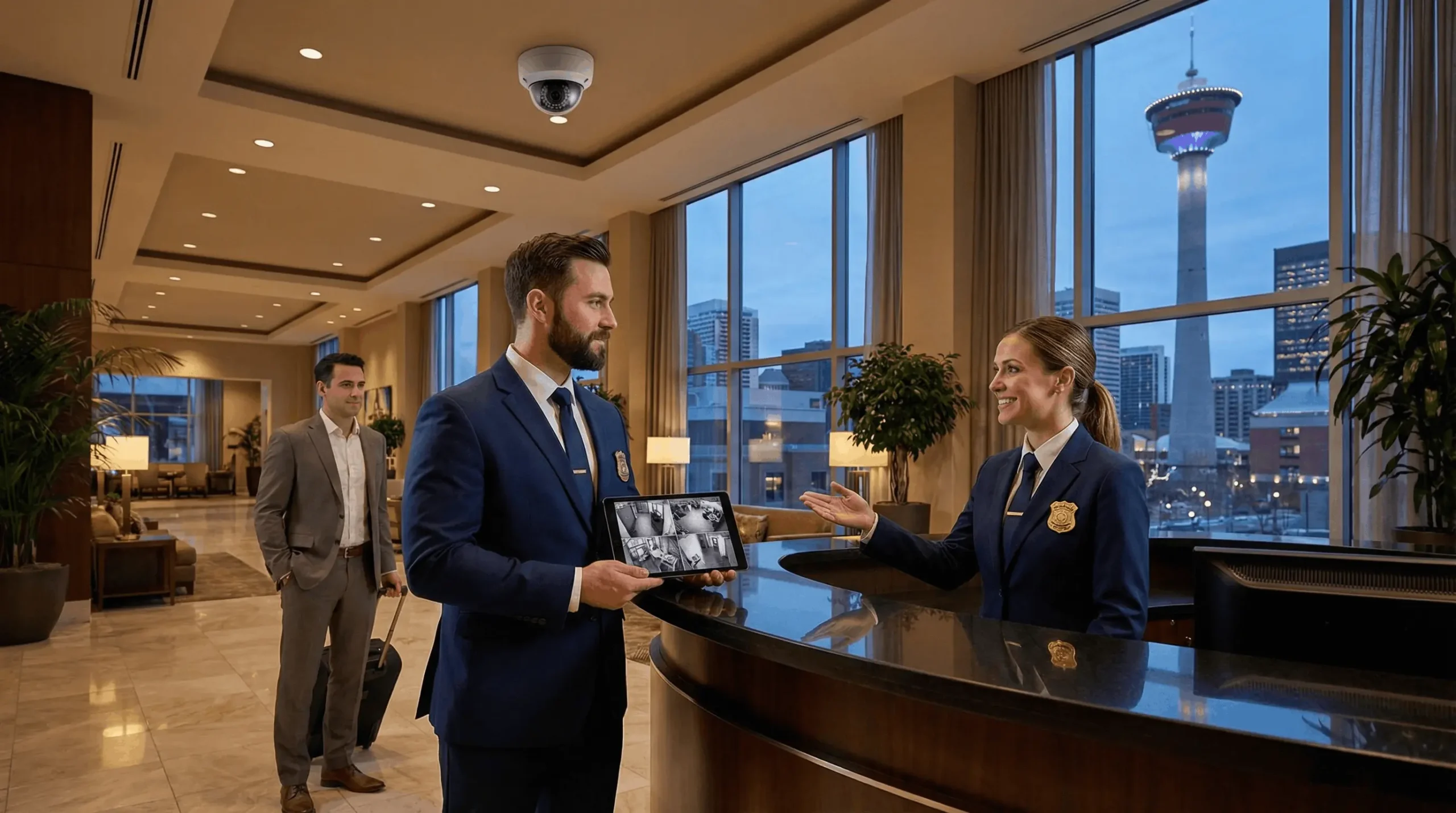
Milestone XProtect video management software enables remote monitoring and real-time alert capabilities that allow Bravo Security's monitoring centre to support on-site officers with additional situational awareness. When an officer responds to an incident, the monitoring centre can provide real-time camera feeds to support the response.
Motorola Solutions MOTOTRBO
Motorola Solutions MOTOTRBO radios provide the communication infrastructure that connects officers, management, and the monitoring centre. In a hotel environment where cellular coverage can be unreliable in lower levels and service areas, dedicated radio communication is not optional.
Seasonal Security Planning for Calgary Hotels
Calgary's hotel security requirements change significantly across the calendar year, and a static security program that does not adapt to seasonal patterns will be over-resourced in slow periods and dangerously under-resourced during peaks.
The Calgary Stampede (July) represents the single highest-risk period for Calgary hotels. Guest volumes increase 30–40%, alcohol consumption rises significantly, and the proportion of unfamiliar visitors to the city creates a higher-than-average incident rate. Bravo Security recommends increasing hotel security staffing by 40–60% during Stampede week, with specific focus on lobby management, parking security, and late-night corridor patrols.
Conference season (September–November) creates a different security profile: high-value business guests, significant laptop and equipment theft risk, and event security requirements for conference functions. The primary security investment during this period should focus on access control for conference areas and dedicated event security for evening functions.
Winter months (December–February) bring reduced guest volumes but specific risks: reduced visibility in parking areas due to snow and ice, increased risk of unauthorized individuals seeking shelter in hotel common areas, and reduced staff alertness during slow periods. Bravo Security's winter protocol includes enhanced parking lot lighting checks, specific protocols for managing individuals seeking shelter, and increased patrol frequency during overnight hours.
How to Evaluate a Security Provider for Your Calgary Hotel
Not all security companies are equipped to serve hotel properties. The following criteria separate providers with genuine hospitality expertise from those applying generic security programs to a specialized environment.
Hospitality-specific training:
Ask specifically about the training curriculum for officers assigned to hotel properties. If the answer is "standard security training," that is insufficient. Hospitality protection requires specific knowledge of guest relations, privacy law, de-escalation in hospitality contexts, and event security management.
Reference properties:
Request references from other Calgary hotel properties, not generic commercial clients. Hospitality security is a specialized discipline, and experience in retail or industrial environments does not transfer directly.
Technology integration capability:
Ask whether the provider can integrate with your existing property management system and access control infrastructure. A security company that cannot integrate with your technology stack will create operational silos that reduce effectiveness.
Incident response documentation:
Request a sample incident response protocol. If the provider cannot produce a written, property-specific protocol, they are not operating at the professional standard your property requires.
Insurance and liability coverage:
Verify that the provider carries adequate liability insurance and that their officers are bonded. This is not a negotiable point — it is a basic requirement for any professional security engagement.
The Guest Privacy Framework: Security Without Surveillance Creep
One of the most common concerns hotel managers raise about professional security services is the risk of creating an environment that feels surveilled rather than safe. This is a legitimate concern, and it reflects a real tension in hospitality security design.
Bravo Security's privacy framework for hotel properties addresses this tension through four principles. First, camera placement follows a strict protocol that excludes all private areas — guest rooms, bathrooms, changing areas — and focuses exclusively on common areas, access points, and service zones. Second, all security personnel are trained in privacy-conscious guest interaction: they do not ask intrusive questions, they do not follow guests, and they do not create visible surveillance of individuals without specific cause. Third, video retention policies are documented and compliant with Alberta's Personal Information Protection Act (PIPA), with footage retained for 30 days and deleted automatically unless required for an active investigation. Fourth, guests are informed of security measures through clear, non-threatening signage that emphasizes safety rather than surveillance.
The result is a security environment that guests experience as reassuring rather than intrusive — which is precisely the balance that drives positive reviews and repeat bookings.
Staff Training: The Human Layer That Technology Cannot Replace
Every technology system in a hospitality protection program depends ultimately on human judgment. A camera that detects an incident is only as useful as the officer who responds to it. An access control system that logs an unauthorized entry is only as effective as the protocol that determines what happens next.
Bravo Security's hospitality officer training program covers six core competencies: guest interaction and de-escalation (the ability to resolve conflicts without escalation is the most valuable skill in hospitality security), emergency response procedures (fire, medical, active threat), privacy and legal compliance (Alberta PIPA, duty of care obligations), report writing and evidence preservation, communication and radio protocols, and physical security procedures (patrol routes, access control management, perimeter checks).
Officers are assessed on these competencies quarterly, not just at initial certification. The hospitality environment changes — new threats emerge, property layouts change, guest profiles shift — and ongoing training ensures that officers adapt rather than operate on outdated protocols.
Ready to Protect Your Calgary Hotel?
Protecting a hotel property is not a commodity decision. The difference between a security program that prevents incidents and one that merely responds to them is the difference between a profitable property and a liability. Bravo Security has protected Calgary hospitality properties across every category — from boutique properties in the Beltline to full-service business hotels downtown — and we understand the specific challenges and opportunities of this market.
A professional property security assessment from Bravo Security takes 90 minutes and produces a written report identifying your property's specific vulnerabilities, recommended security model, technology requirements, and projected costs. There is no obligation and no pressure. The assessment is designed to give you the information you need to make a sound decision — whether that decision involves Bravo Security or not.
Request a free security assessment today and discover what professional hotel security actually looks like for your property.
Related Services
- Security Guard Services — Trained officers for any commercial property
- Mobile Patrol Services — Flexible patrol coverage for large properties
- Event Security Services — Dedicated event protection for conferences and functions
- Loss Prevention Services — Asset protection and theft reduction programs
- Condominium Security Solutions — Residential community protection
- Healthcare Security Services — Specialized protection for medical facilities
- Construction Security Solutions — Site protection for active construction projects
- Bank Security Guard Services — Financial institution security programs
- Retail Security Services — Loss prevention for retail environments
- Commercial Property Security — Office and commercial building protection