Construction Security Solutions in Calgary: The Complete Guide to Protecting Your Site
A $2.3 million mixed-use development in Calgary's Beltline district. Fourteen months into construction. A Friday night in January — minus 28°C, wind chill pushing it to minus 38°C. The site manager got the call at 2:47 a.m.: someone had cut through the perimeter fence, loaded a pickup truck with $74,000 worth of copper wiring, and vanished before the alarm company even dispatched a response.
The worst part? It was the third incident in six weeks. Each time, the thieves adapted. They knew the camera blind spots. They knew the patrol schedule. They knew exactly when the site was most vulnerable.
That project ended up $210,000 over budget — not just from stolen materials, but from project delays, insurance deductibles, crew overtime to catch up on schedule, and the premium hike on their next policy renewal.
I tell you this story not to scare you, but because it represents a pattern we see repeatedly across Calgary's construction industry. And it's almost entirely preventable with the right construction security solutions in place from day one.
What Are Construction Security Solutions?
Construction security solutions are integrated systems combining physical security, technology, and trained personnel to protect active construction sites from theft, vandalism, unauthorized access, and liability exposure. Unlike static building security, construction security must adapt continuously as the site evolves — from a fenced lot to a completed structure.
The most effective construction security solutions aren't just about deterrence. When you invest in purpose-built construction security solutions, you're investing in your project's timeline, budget, and reputation. They're about creating layered protection that makes your site the hardest target on the block. When thieves case a neighbourhood of construction sites — and they absolutely do — they're looking for the path of least resistance. Your job is to ensure that path doesn't run through your project.
At Bravo Security, we've protected construction sites ranging from single-family residential builds in Tuscany to $400 million commercial towers in the East Village. What we've learned is that no two sites have identical security needs, but every site shares the same fundamental vulnerabilities — and the same fundamental solutions.
Why Are Calgary Construction Sites Targeted So Frequently?
Let's be honest about something most security companies won't say: Calgary has a construction theft problem that's significantly worse than the national average. The combination of a booming construction market, long winter nights, and a sophisticated network of organized theft rings makes the city one of the highest-risk environments in Western Canada for construction site crime.
The numbers are sobering. Across North America, construction sites lose an estimated $1 billion annually to theft, with recovery rates hovering around 25%. In Alberta specifically, equipment theft claims increased 34% between 2022 and 2025, according to industry insurance data. The average loss per incident in Calgary runs between $45,000 and $180,000 when you factor in project delays, not just replacement costs.
What makes Calgary particularly vulnerable? Three factors stand out. First, the city's construction boom means more sites competing for limited security resources. Second, the extreme winter weather creates natural blind spots — heavy snowfall obscures cameras, cold temperatures reduce patrol frequency, and early darkness extends the overnight vulnerability window to 16+ hours. Third, the proximity to major transportation corridors makes it easy for organized theft rings to move stolen equipment quickly across provincial lines.
Understanding these local dynamics is why generic construction security solutions often fail in Calgary. You need a provider who understands the specific threat environment, not one applying a one-size-fits-all template.
The Real Cost of Construction Site Theft Goes Far Beyond Replacement Value
Here's what project managers consistently underestimate: the direct cost of stolen materials is usually the smallest part of the total loss.
When a $40,000 excavator attachment disappears on a Tuesday night, the obvious cost is the replacement value. But the real cost includes the three-day project delay while you source a replacement, the overtime premium to catch up on schedule, the subcontractor standby costs while your crew waits, the insurance deductible, the premium increase at renewal, and the reputational damage if delays affect your client relationship.
We worked with a Calgary commercial developer in Q3 2024 who suffered a single copper theft incident valued at $28,000. By the time they tallied all associated costs — delays, insurance, crew overtime, security upgrades forced by their insurer — the total impact exceeded $195,000. That's a 7:1 multiplier on the direct theft value.
This is why construction security solutions should be evaluated not as a cost, but as risk mitigation with a calculable ROI. A $4,500/month security program that prevents even one mid-size theft incident per year generates a positive return in the first incident alone.
Construction Security by Project Phase: What You Need and When
One of the most common mistakes we see is treating construction security as a static deployment. In reality, your security needs change dramatically as your project progresses. Here's how we approach phase-based security planning:
Pre-Construction and Site Preparation (Months 1–2)
This phase carries the highest risk relative to value on site. You have expensive equipment — excavators, compactors, survey equipment — but minimal physical structure to deter access. Priority: perimeter fencing, equipment GPS tracking, and mobile patrol coverage during non-working hours.
Foundation and Structural Phase (Months 3–8)
As the project value on site increases, so does the target profile. Copper, rebar, and structural steel become attractive targets. This phase typically requires a combination of on-site guard presence during overnight hours and camera surveillance covering material storage areas.
Mechanical, Electrical, and Plumbing Phase (Months 9–18)
This is the highest-risk phase for copper theft specifically. Electrical rough-in materials can represent $200,000+ in a single building. We recommend dedicated overnight guard coverage during this phase, with camera monitoring of all electrical material storage areas.
Finishing and Pre-Occupancy Phase (Final Months)
As the building nears completion, the risk profile shifts from material theft to vandalism, trespassing, and liability exposure. Access control becomes critical — you need to know exactly who is on site at all times as you approach occupancy inspections.
Physical Security: Building the Foundation of Your Protection Plan
No technology replaces a well-designed physical security perimeter. Before cameras, before guards, before alarms — the physical layout of your site either invites or deters criminal activity.
Perimeter Fencing and Barriers
Chain-link construction fencing is the minimum standard, but it's not sufficient on its own. We recommend 8-foot hoarding panels for high-value sites, with anti-climb features at corners and gate points. Every gap in your perimeter is an invitation. We've seen sites where a 4-foot gap between fence panels was the entry point for three separate theft incidents.
Lighting
This is the single most underinvested element of construction security. Thieves operate in darkness — it's that simple. LED flood lighting covering all material storage areas, equipment parking zones, and perimeter access points eliminates the low-risk environment that makes your site attractive. Motion-activated lighting adds an additional deterrent layer at lower operating cost.
Access Control
A controlled single-point entry with a staffed gate during working hours dramatically reduces unauthorized access. Keypad or card-reader systems for after-hours access create an audit trail that's invaluable when incidents occur.
Technology Solutions: Cameras, Alarms, and GPS Tracking
Modern construction security technology has advanced significantly in the past five years. Here's an honest assessment of what works, what doesn't, and what's worth the investment.
CCTV Surveillance Systems
Axis Communications and Hikvision cameras are the industry workhorses for construction sites. Both offer weatherproof housings rated for Calgary's extreme temperature range (−40°C to +60°C). The key is camera placement — most construction site camera installations we've inherited have significant blind spots because cameras were positioned for aesthetics rather than coverage.
For a mid-size construction site (1–3 acres), expect 12–20 cameras for comprehensive coverage. Solar-powered temporary camera towers from companies like Stealth Monitoring are excellent for sites without permanent power infrastructure.
Video Monitoring and Analytics
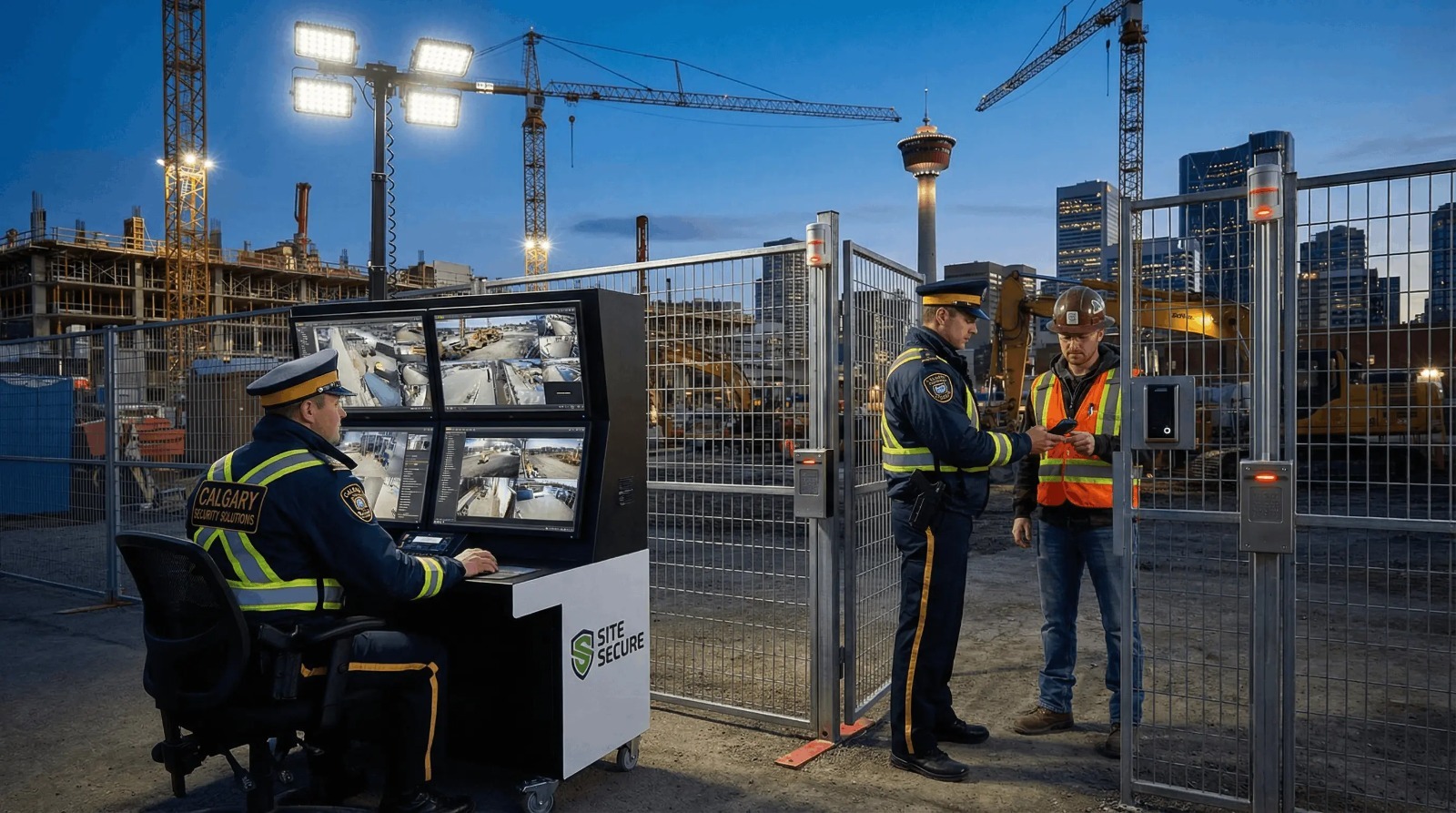
Passive camera recording is nearly useless as a deterrent — it only helps after an incident occurs. Active video monitoring, where a remote monitoring center watches live feeds and can trigger audio warnings, is dramatically more effective. Bravo Security's mobile patrol services integrate with active video monitoring for rapid on-site response when alerts are triggered.
AI-powered video analytics from platforms like Genetec and Milestone can detect perimeter breaches, loitering, and unusual activity patterns — reducing false alarms while improving response accuracy.
GPS Tracking for Equipment
Caterpillar's Cat Connect, Trimble's Telematics, and third-party solutions like Samsara provide GPS tracking for heavy equipment. Recovery rates for GPS-tracked equipment run 3–4x higher than untracked assets. The cost — typically $25–$50/month per unit — is negligible compared to the replacement value of the equipment.
Alarm Systems
Wireless alarm systems from companies like Bosch and Honeywell can be deployed on construction sites without permanent infrastructure. Motion sensors, door/window contacts on storage containers, and vibration sensors on high-value equipment provide early warning capability.
Personnel Solutions: Guards, Patrols, and Monitoring
Here's the honest truth about construction security guards that most companies won't tell you: a single guard watching a 3-acre site overnight cannot provide comprehensive coverage. The math doesn't work. One person cannot be in multiple places simultaneously.
What guards do exceptionally well is provide a visible deterrent presence, respond to alerts from camera systems, conduct regular patrols on defined routes, and manage access control at entry points. What they cannot do is watch every corner of a large site simultaneously.
This is why we advocate for a hybrid model: technology provides the eyes, guards provide the response capability and human judgment. A guard supported by active video monitoring is 4–5x more effective than a guard operating without technological support.
On-Site Guard Services
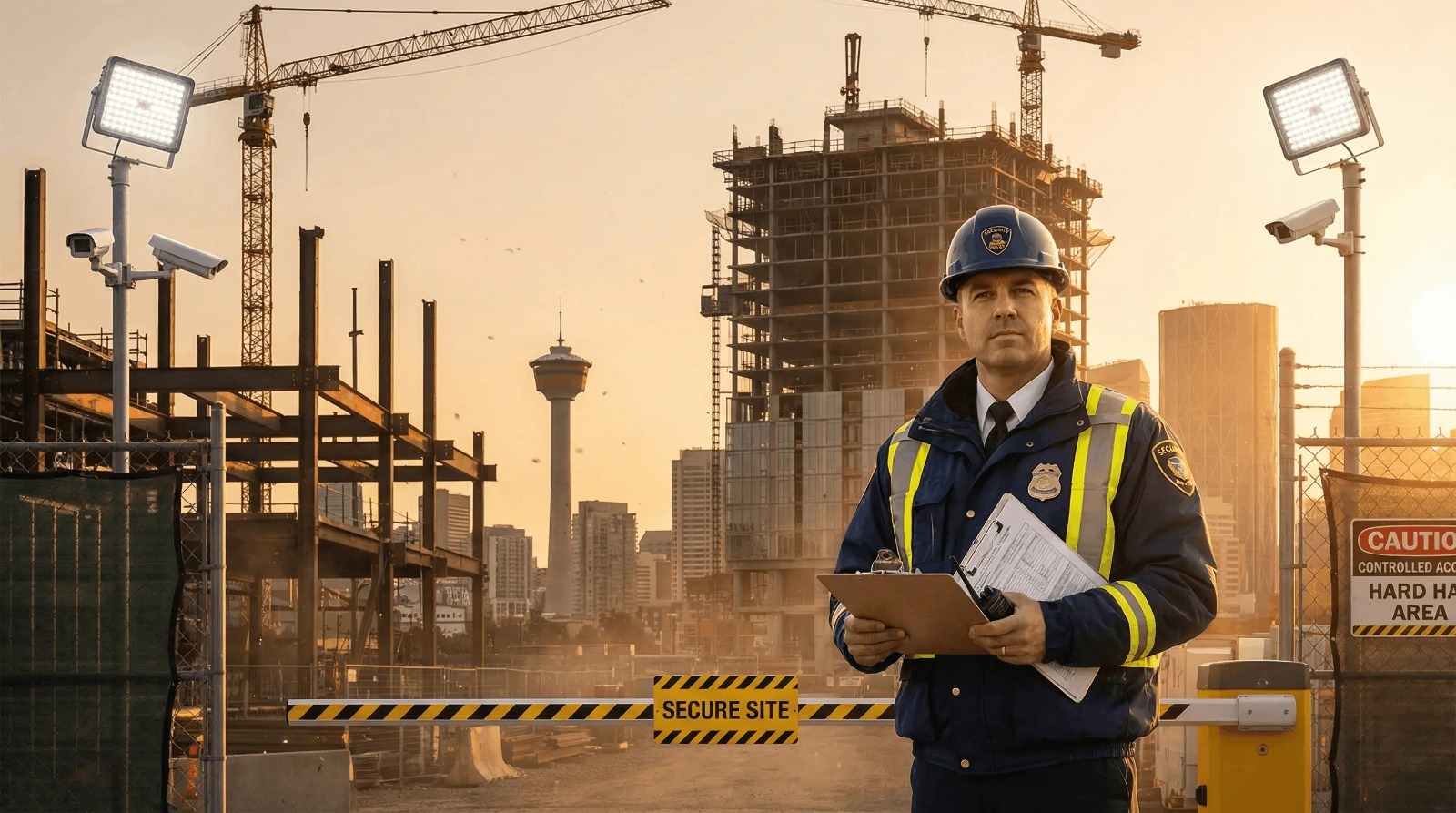
For high-value sites or during high-risk phases (particularly the MEP phase), dedicated overnight guard presence is the gold standard. Our security guard services deploy guards trained specifically for construction environments — they understand site hazards, know how to conduct effective patrols, and are trained in incident documentation and reporting.
Mobile Patrol Services
For sites where full-time overnight guard presence isn't cost-justified, mobile patrol provides a cost-effective alternative. Our patrol vehicles conduct randomized visits throughout the night — typically 4–6 visits per shift — creating unpredictability that deters organized theft rings. The key word is "randomized." Predictable patrol schedules are quickly learned and exploited.
How Much Does Construction Security Cost in Calgary?
Transparency on pricing is something most security companies avoid. We don't. Here's what you can realistically expect to pay for construction security solutions in Calgary as of Q1 2026:
Security Solution | Monthly Cost Range | Best For |
Mobile Patrol (4–6 visits/night) | $1,800–$3,200 | Small sites, lower-risk phases |
On-Site Guard (overnight, 10 hrs) | $4,500–$7,200 | High-value sites, MEP phase |
Camera Installation (12–20 cameras) | $8,000–$22,000 (one-time) | All sites |
Active Video Monitoring | $800–$1,800/month | Sites with camera infrastructure |
GPS Tracking (per unit) | $25–$50/month | All heavy equipment |
Comprehensive Package (guard + cameras + monitoring) | $6,500–$12,000/month | Large commercial projects |
These ranges reflect Calgary market rates. Beware of providers quoting significantly below these ranges — in our experience, below-market pricing correlates directly with below-standard guard quality, inadequate supervision, and poor incident response.
Calgary Winter Construction Security Challenges
Winter is when Calgary construction sites are most vulnerable, and it's when most security providers perform worst. Effective construction security solutions must account for Calgary's extreme seasonal conditions — something no competitor in this market adequately addresses. Here's what changes in winter and how to adapt:
Extended Darkness
In December and January, Calgary experiences approximately 16 hours of darkness. That's 16 hours of reduced visibility, reduced deterrence, and increased vulnerability. Your lighting infrastructure needs to be designed for winter conditions — not just summer coverage.
Camera Performance
Standard IP cameras perform poorly below −25°C. Lens fogging, reduced image quality, and complete failure are common with inadequate equipment. Ensure your camera specifications include Arctic-rated housing and heating elements for Calgary winters.
Guard Welfare and Performance
Guards working in extreme cold require proper equipment, heated patrol vehicles, and scheduled warm-up breaks. A guard who is physically compromised by cold cannot perform effective security duties. Any construction security provider operating in Calgary should have explicit cold-weather protocols for their personnel.
Snow and Ice
Heavy snowfall can obscure camera views, block lighting, and create physical security gaps as fencing settles or shifts. Regular site inspections after major snowfall events are essential.
Three Calgary Construction Security Case Studies
Case Study 1: Beltline Mixed-Use Development (Q4 2024)
A 14-storey mixed-use project in Calgary's Beltline had experienced three copper theft incidents in six weeks, totalling $74,000 in direct losses. The developer engaged Bravo Security mid-project.
Our assessment identified three critical vulnerabilities: a camera blind spot covering the northeast corner of the site, a predictable patrol schedule that thieves had clearly mapped, and inadequate lighting in the material storage area.
Solution deployed: 4 additional cameras eliminating the blind spot, randomized patrol schedule with GPS-verified patrol documentation, and LED flood lighting upgrade in storage areas. Cost: $2,800/month for patrol services plus $4,200 one-time camera installation.
Result: Zero theft incidents in the subsequent 8 months of the project. Insurance premium reduction at renewal: $14,000 annually. Total ROI on security investment: 340% in year one.
Case Study 2: Residential Subdivision, NW Calgary (Q1 2025)
A 47-unit residential subdivision in northwest Calgary was experiencing weekly tool theft from individual home builds. The general contractor estimated losses of $8,000–$12,000 per month across the project.
Our solution: GPS tracking on all high-value equipment, a centralized secure tool storage container with alarm monitoring, and mobile patrol coverage during overnight hours.
Result: Tool theft dropped 94% within 30 days. Monthly security cost: $2,200. Monthly savings: $9,500+. The GC recovered their annual security investment in 2.7 months.
Case Study 3: Commercial Tower, Downtown Calgary (Q2–Q3 2025)
A $180 million commercial tower in downtown Calgary required comprehensive security during the high-risk MEP phase. The project had 24 subcontractors on site simultaneously, creating significant access control challenges.
We deployed a dedicated access control system with biometric verification, 22-camera CCTV system with active monitoring, and two overnight guards supported by the monitoring center.
Result: Zero theft incidents during the 6-month MEP phase. Unauthorized access attempts (detected and prevented): 34. Insurance certificate maintained without incident surcharges. Estimated theft prevention value based on comparable projects: $280,000+.
How to Evaluate Construction Security Providers in Calgary
Not all construction security companies are equal, and choosing the wrong provider is often more expensive than having no security at all. Here's a 6-point framework for evaluating construction security solutions providers:
1. Construction-Specific Experience
Ask specifically about construction site experience, not just general commercial security. Construction environments have unique hazards, access control requirements, and theft patterns. A provider without specific construction experience will apply generic protocols that don't address your actual risks.
2. Guard Training and Certification
In Alberta, security guards must hold a valid Security Services licence issued under the Security Services and Investigators Act. Beyond the minimum, ask about construction-specific training: site hazard awareness, access control procedures, incident documentation, and cold-weather protocols.
3. Technology Integration
Can the provider integrate with your existing camera infrastructure? Do they offer active monitoring or only passive recording? Do they have GPS-verified patrol documentation? These aren't nice-to-haves — they're the difference between security theatre and actual protection.
4. Response Times
What is the guaranteed response time for alarm activations? What is the escalation protocol? Who do you call at 3 a.m. when something happens? Get specific commitments in writing, not vague assurances.
5. Insurance and Liability
Your security provider should carry minimum $5 million commercial general liability insurance and $2 million errors and omissions coverage. Ask for certificates of insurance — not just verbal confirmation.
6. References from Similar Projects
Ask for references from construction projects of similar size and type. A provider who has secured residential builds but never managed a commercial tower security program is not the right choice for a $200 million project.
Insurance Impact and Emergency Response Protocols
How Construction Security Affects Your Insurance Premiums
This is the conversation most project managers never have with their security provider — and it's one of the most financially significant.
Construction site insurance premiums are directly influenced by your security posture. Insurers evaluate your security program when underwriting your builder's risk policy and when determining premiums at renewal. A documented, professional security program can reduce your annual premium by 15–25% compared to a site with minimal security measures.
More importantly, a single major theft incident without adequate security documentation can trigger a policy review, premium surcharge, or in some cases, policy cancellation. We've seen projects lose their builder's risk coverage mid-construction after a major theft incident — a catastrophic outcome that makes the cost of professional security look trivial by comparison.
Bravo Security provides detailed incident reports, patrol logs, and security documentation specifically formatted for insurance purposes. Our security guard services include documentation protocols that satisfy insurer requirements and support premium reduction negotiations.
Emergency Response Protocols for Construction Sites
When an incident occurs on your construction site, the next 30 minutes determine the outcome. Here's the emergency response framework we deploy:
Tier 1 — Alarm Activation (0–5 minutes)
Active monitoring center detects alarm or camera alert. Operator assesses situation via live camera feed. If threat confirmed: immediate dispatch of nearest mobile patrol unit, notification to site supervisor, and 911 call if criminal activity is confirmed.
Tier 2 — On-Site Response (5–20 minutes)
Mobile patrol or on-site guard responds to incident location. Situation assessment and containment. Evidence preservation — no movement of items until police arrive. Documentation begins immediately: photos, video, witness statements.
Tier 3 — Incident Documentation (20–60 minutes)
Comprehensive incident report completed. Police report filed and report number obtained. Site supervisor and project manager notified. Insurance notification initiated if threshold exceeded. Security assessment to identify how incident occurred and prevent recurrence.
Tier 4 — Post-Incident Review (24–48 hours)
Full security audit of incident circumstances. Recommendations for security improvements. Updated risk assessment. Insurance documentation package prepared.
Why Bravo Security for Your Calgary Construction Site
We've been protecting Calgary construction sites since the city's last major development boom, and we've learned some hard lessons along the way — lessons that inform everything we do today.
We learned that generic security programs fail construction sites. We learned that predictable patrol schedules are worse than no patrol at all. We learned that cameras without active monitoring are expensive decorations. And we learned that the security providers who win long-term client relationships are the ones who treat their clients' projects like their own.
Our construction security solutions are built on those lessons. Every program starts with a site-specific risk assessment. Every deployment includes technology integration. Every guard is trained for construction environments. And every client gets a dedicated account manager who knows their project and picks up the phone at 3 a.m.
If you're managing a Calgary construction project — at any stage, at any scale — we'd like to show you what professional construction security looks like. Not a sales pitch. A real conversation about your specific risks and the most cost-effective way to address them.
Connect with our team through our contact page or request a free security assessment for your site. We'll have a proposal in your hands within 24 hours.
Related Services
- Mobile Patrol Services — Randomized overnight patrols for cost-effective site protection
- Security Guard Services — Trained guards for on-site presence and access control
- Video Monitoring Services — Active monitoring with rapid response capability
- Truck Yard Security — Specialized security for logistics and transportation facilities
- Commercial Security Solutions — Comprehensive security for commercial properties
- Event Security Services — Professional security for corporate and public events