Healthcare Security Services in Calgary: What Actually Protects Your Staff and Patients
It was a Tuesday afternoon at a mid-sized Calgary medical clinic when a patient in the waiting room escalated from frustrated to physically threatening in under ninety seconds. The front desk nurse pressed the silent alarm. Nothing happened. The security guard on duty was doing a perimeter check outside. By the time he returned, a physician had a broken wrist and three staff members had filed incident reports.
The clinic had a security guard. They had cameras. They had an alarm system. What they didn't have was a coordinated healthcare security services program built specifically for medical environments.
The data is stark: Healthcare workers are five times more likely to experience workplace violence than employees in any other sector. In Alberta alone, reported violent incidents in healthcare settings increased 41% between 2019 and 2024. Yet most security programs deployed in medical facilities were designed for retail or commercial environments — not for the specific, emotionally charged, high-stakes world of patient care.
This guide covers what genuine healthcare security services look like, what separates effective programs from expensive placeholders, and how Calgary facilities can build security that actually works when it matters most. Whether you manage a single clinic or a multi-site hospital network, the principles of effective healthcare security services remain consistent.
What Are Healthcare Security Services and Why Do Generic Solutions Fail?
Healthcare security services are specialized security programs designed for hospitals, clinics, long-term care facilities, mental health centres, and other medical environments. The key word is "specialized." A security guard trained for retail loss prevention is not equipped to manage a patient experiencing a psychotic episode. A camera system designed for a parking garage does not account for HIPAA-compliant placement in patient care areas.
Generic security fails in healthcare for three specific reasons. This is why purpose-built healthcare security services exist as a distinct discipline — not a variation on commercial security. First, the threat profile is fundamentally different. Aggression in healthcare settings often comes from patients in pain, family members under extreme stress, or individuals experiencing mental health crises — not from criminals with premeditated intent. Second, the response requirements are different. Restraint and removal are often inappropriate when the aggressor is a vulnerable patient. Third, the regulatory environment is different. Every security decision in a medical facility must account for patient privacy, dignity, and rights under provincial and federal health legislation.
Effective healthcare security services are built around these realities from the ground up, not retrofitted from a commercial template.
The Five Pillars of Effective Healthcare Security
After working with Calgary medical facilities ranging from 12-bed clinics to 400-bed hospital campuses, we've identified five pillars that separate genuinely protective healthcare security services from those that merely create the appearance of security.
Pillar 1: Specialized Guard Training.
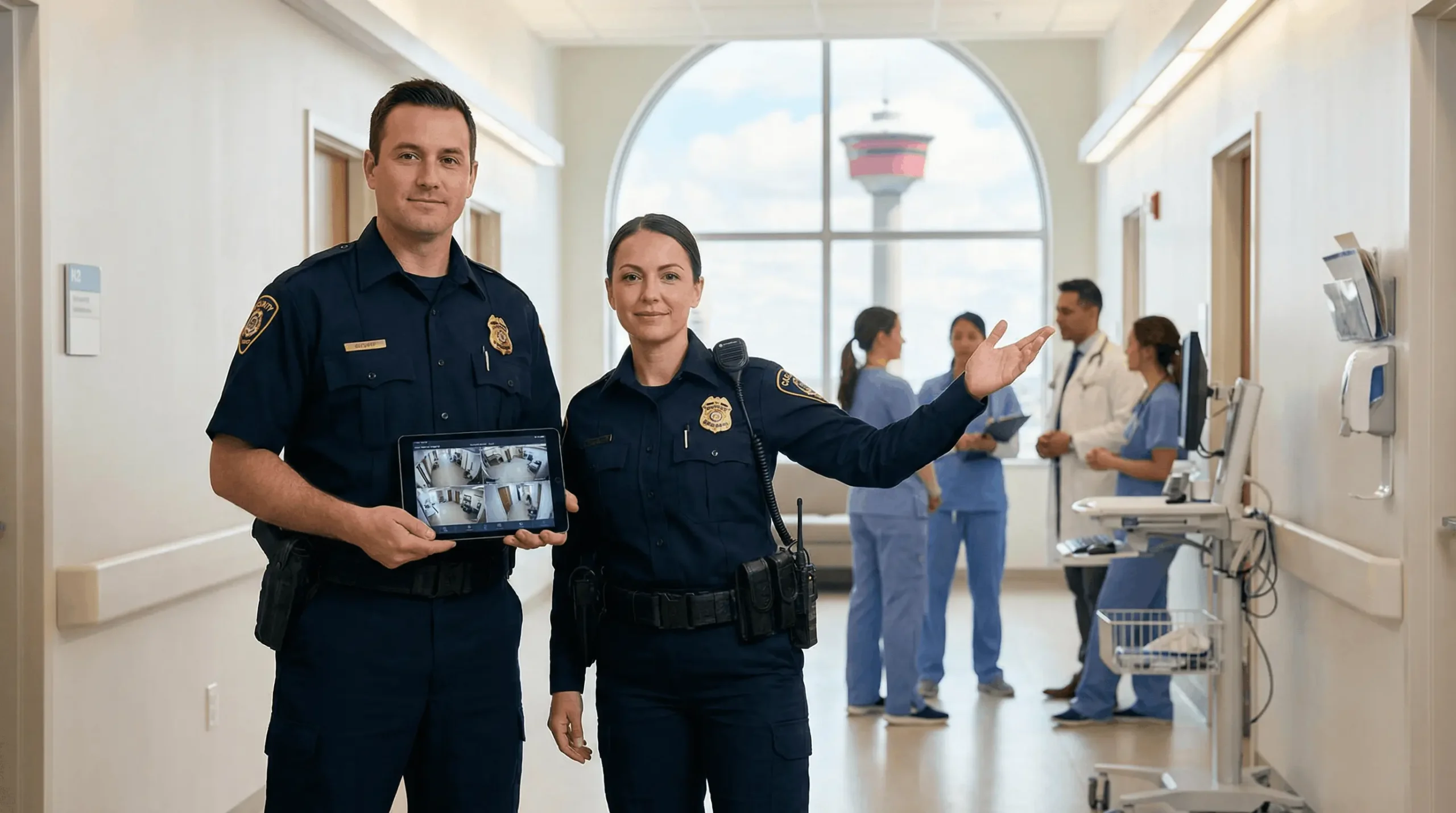
Healthcare security officers require training that goes far beyond standard guard certification. At minimum, this includes mental health first aid, non-violent crisis intervention (CPI certification), de-escalation communication, trauma-informed response, and healthcare-specific emergency protocols. At Bravo Security, every officer deployed to a healthcare site completes a 40-hour healthcare orientation before their first shift.
Pillar 2: Integrated Protocols.
Security cannot operate as a separate department. Effective programs integrate security officers into clinical workflows, establish clear communication channels with nursing staff, and define precise escalation pathways for different incident types.
Pillar 3: Technology That Serves People.
Cameras, access control, and alarm systems are force multipliers — but only when they're configured for healthcare environments and actively monitored. A camera that records an incident is not the same as a system that prevents one.
Pillar 4: Visitor Management.
Uncontrolled visitor access is one of the most overlooked security vulnerabilities in healthcare settings. Robust visitor management systems — including check-in protocols, badge systems, and visiting hour enforcement — reduce incident rates significantly.
Pillar 5: Continuous Assessment.
Healthcare environments change constantly. New units open, patient populations shift, staff turnover affects awareness. Security programs that aren't regularly audited and updated become obsolete within months.
Why De-Escalation Is the Most Important Skill Your Security Team Needs
Here's the opinion that makes some security companies uncomfortable: physical intervention should be the last resort in almost every healthcare security scenario, not a standard response option.
The research backs this up. A 2023 study published in the Journal of Emergency Nursing found that facilities using structured de-escalation training reduced physical restraint incidents by 68% over 24 months. More importantly, they reduced staff injuries by 54% — because de-escalation prevents the situation from reaching the point where physical intervention becomes necessary.
De-escalation in healthcare requires a specific skill set. It starts with environmental awareness — recognizing the early warning signs of escalation before they become visible to untrained staff. It continues with verbal communication techniques that acknowledge distress without reinforcing agitation. It includes spatial positioning that maintains safety without triggering defensiveness. And it requires the emotional regulation to stay calm when a patient or family member is not.
Our security guard services include healthcare-specific de-escalation training based on the Crisis Prevention Institute (CPI) model, supplemented with scenario-based practice developed from real Calgary healthcare incidents. Officers practice managing aggressive patients, distressed family members, and individuals experiencing mental health crises — because each scenario requires a different approach.
The honest admission here: de-escalation is not a magic solution. Some situations require physical intervention. Some require police involvement. The goal of a strong de-escalation program is not to eliminate all physical incidents — it's to ensure that every physical incident that does occur was genuinely unavoidable, not the result of poor communication or premature escalation.
Mental Health Crisis Response: The Gap Most Security Programs Miss
Calgary's healthcare facilities are seeing a significant increase in patients presenting with acute mental health crises. The Sheldon M. Chumir Health Centre, which operates as a 24-hour urgent care facility, has reported a 37% increase in mental health-related visits since 2022. Similar trends are visible across the Alberta Health Services network.
Standard security training does not prepare officers for mental health crisis response. The techniques that work for an agitated visitor — direct commands, firm boundaries, visible authority — can actively worsen a psychiatric emergency. An officer who doesn't understand the difference between a patient experiencing a manic episode and one who is intoxicated will make the wrong call, potentially causing harm.
Effective healthcare security services include specific mental health crisis response training. This covers recognition of common psychiatric presentations, communication techniques for different mental health conditions, understanding of involuntary psychiatric holds under the Mental Health Act, and coordination with clinical staff during psychiatric emergencies.
We've seen this matter in practice. In Q3 2024, a Bravo Security officer at a Calgary urgent care clinic recognized early signs of a dissociative episode in a patient who had been waiting for three hours. Rather than approaching with standard security protocols, the officer used trauma-informed communication techniques, notified the charge nurse, and helped facilitate an immediate clinical assessment. The situation resolved without incident. A standard security response would likely have triggered a full escalation.
Access Control and Visitor Management: The Overlooked Frontline
Most healthcare security conversations focus on responding to incidents. Far less attention goes to preventing them — and visitor management is where prevention happens.
Uncontrolled visitor access creates multiple security vulnerabilities. Unauthorized individuals can access restricted areas, including medication storage, patient records, and intensive care units. Visitors who are themselves at risk — individuals with restraining orders, estranged family members, individuals in crisis — can reach vulnerable patients before staff are aware of the threat.
Effective visitor management for healthcare facilities includes several components that work together. Electronic check-in systems capture visitor identity and purpose of visit, creating a searchable record. Badge systems provide visible identification and can be programmed with time limits and access restrictions. Visiting hour protocols, consistently enforced, reduce the volume of uncontrolled access during high-risk periods. Alert systems flag individuals who have been previously identified as security concerns.
Our mobile patrol services complement on-site visitor management by providing coverage during shift changes and overnight periods when staffing is reduced. The combination of on-site officers and mobile patrol creates layered coverage without the cost of full 24-hour on-site staffing.
One practical note on visitor management that most security providers won't tell you: the biggest barrier to effective visitor management in healthcare is not technology — it's staff compliance. When nurses let family members bypass check-in because they recognize them, when doctors prop open restricted-area doors for convenience, the system fails. Effective implementation requires staff education and leadership buy-in, not just hardware installation.
Healthcare Security Technology: What Works, What's Overhyped, and What You Actually Need
The security technology market is full of impressive-sounding solutions. AI-powered threat detection, facial recognition, gunshot detection sensors, predictive analytics. Some of these are genuinely valuable. Others are expensive distractions from the fundamentals.
Here's an honest assessment of the technologies that matter most for Calgary healthcare facilities.
High-Definition CCTV with Active Monitoring:
Cameras are only as useful as the monitoring behind them. A 64-camera system reviewed by a single guard on a 12-hour shift has significant blind spots — not in coverage, but in attention. The most effective camera deployments combine strategic placement with active monitoring protocols and regular footage review. Avigilon and Genetec are the leading platforms in the Calgary market; both offer healthcare-specific configurations that account for patient privacy requirements.
Access Control Systems:
Electronic access control is the single highest-ROI security investment for most healthcare facilities. Systems like Lenel S2 and Honeywell Pro-Watch allow granular control over who can access which areas, at what times, with complete audit trails. The key is configuration — a poorly configured access control system creates false confidence while leaving critical vulnerabilities open.
Panic and Duress Systems:
Staff-worn panic devices and fixed duress buttons are essential in high-risk areas including emergency departments, psychiatric units, and medication storage areas. The Motorola Solutions portfolio and Zetron communication systems are commonly deployed in Calgary healthcare settings. Response time from activation to officer arrival should be under 90 seconds in any properly designed system.
What's Overhyped:
AI gun detection systems are valuable in high-risk environments like emergency departments in major trauma centres. For most Calgary clinics and mid-sized facilities, the cost-benefit ratio doesn't support the investment. The same budget deployed toward additional officer training and improved visitor management will prevent more incidents.
Three Calgary Healthcare Security Case Studies
Case Study 1: Urgent Care Clinic — Reducing Incident Rate by 61%
A Calgary urgent care clinic with 18 exam rooms and approximately 280 daily patient visits was experiencing an average of 4.2 security incidents per week, including verbal threats, property damage, and two physical assaults on staff in a six-month period. The existing security program consisted of one unarmed guard and a basic CCTV system.
Bravo Security conducted a full security assessment in August 2024. The assessment identified three critical gaps: no de-escalation training for security staff, no visitor management system, and no communication protocol between security and clinical staff. We implemented a revised program including two trained healthcare security officers per shift, a structured visitor management process, and a clinical-security communication protocol.
By February 2025 — six months post-implementation — weekly incident rate had dropped to 1.6, a 61% reduction. Staff reported significantly higher confidence in their personal safety. The clinic's insurance provider reduced their liability premium by 14%.
Case Study 2: Long-Term Care Facility — Protecting Vulnerable Residents
A 120-bed long-term care facility in northwest Calgary was experiencing a pattern of unauthorized visitor access, including two incidents involving individuals who had been legally prohibited from contacting specific residents. The facility had no formal visitor management system and relied on front desk staff to recognize and flag concerning visitors.
We implemented an electronic visitor management system integrated with a restricted-visitor alert database, combined with access control upgrades to the residential wings. Staff received training on visitor management protocols and escalation procedures. In the 12 months following implementation (Q4 2024 through Q3 2025), there were zero unauthorized access incidents involving restricted individuals, compared to four in the preceding 12 months.
Case Study 3: Medical Office Building — Multi-Tenant Security Coordination
A five-storey medical office building in Calgary's Beltline district housing 23 separate medical practices faced a coordination challenge common to multi-tenant healthcare environments: each tenant had different security needs, different operating hours, and different patient populations, but shared common areas including lobbies, elevators, and parking.
We developed a unified commercial security program that provided consistent coverage for common areas while accommodating the specific requirements of individual tenants. A single security officer per shift covered the building using a structured patrol protocol, supported by an integrated camera system accessible to all tenant practices. Incident response time for tenant-reported concerns dropped from an average of 8 minutes to under 2 minutes. Three tenants reported the improved security environment as a factor in lease renewal decisions.
What Healthcare Security Services Actually Cost in Calgary
The honest answer is: it depends significantly on your facility type, size, operating hours, and risk profile. Here's the current market range for Calgary healthcare security services as of Q1 2026.
Service Model | Typical Monthly Cost | Best For |
Single unarmed officer, business hours | $4,800 – $6,200 | Small clinics, medical offices |
Single officer, 24/7 coverage | $11,500 – $14,000 | Urgent care, pharmacies |
Two officers, 24/7 coverage | $21,000 – $26,000 | Mid-sized hospitals, large clinics |
Hybrid: on-site + mobile patrol | $8,500 – $12,000 | Multi-location practices, LTC facilities |
Technology-only (cameras + access control) | $2,500 – $4,500 setup + $800/month monitoring | Low-risk medical offices |
These figures reflect fully trained, healthcare-certified officers with appropriate supervision and management overhead. Significantly lower quotes typically reflect reduced training standards, inadequate supervision ratios, or hidden costs that emerge after contract signing.
The ROI calculation for healthcare security is not just about preventing incidents. It includes staff retention (healthcare facilities with strong security programs report 23% lower security-related turnover), liability reduction (documented security programs reduce settlement costs in workplace violence claims), and operational continuity (incidents that disrupt patient care have direct revenue implications).
How to Evaluate a Healthcare Security Services Provider
Most security companies will tell you they specialize in healthcare. Very few actually do. Here's how to distinguish genuine healthcare security expertise from a standard security company that added "healthcare" to their service list.
Ask for specific healthcare training documentation. What certifications do their officers hold? Is CPI (Crisis Prevention Institute) certification standard or optional? Do they have mental health first aid training? Can they provide training records for the specific officers who would be assigned to your facility?
Ask for healthcare-specific references. Not just any references — references from facilities similar to yours in size, patient population, and risk profile. Ask those references specifically about incident response, de-escalation outcomes, and staff feedback.
Ask about their HIPAA and provincial privacy compliance protocols. How do they handle camera footage in patient care areas? What are their data retention and access policies? Do they have a documented privacy compliance program?
Ask about their management and supervision model. How many officers does each supervisor oversee? What is the response time if an assigned officer doesn't show for a shift? How are incidents documented and reported to facility management?
Our contact us page includes a free security assessment offer specifically for healthcare facilities. The assessment covers your current security program, identifies specific vulnerabilities, and provides a written recommendation — with no obligation to engage our services.
Staff Training and Security Awareness: The Human Layer
Technology and trained security officers are essential. But the most effective healthcare security programs also invest in security awareness training for clinical and administrative staff.
Staff who understand how to recognize early warning signs of escalation can alert security before situations develop. Staff who know the correct escalation procedures don't improvise in high-pressure moments. Staff who feel genuinely supported by their security program are more likely to report concerns and less likely to develop the normalized tolerance of unsafe conditions that makes many healthcare environments more dangerous than they need to be.
Effective staff security training for healthcare environments covers de-escalation awareness (not the same as officer-level de-escalation training, but enough to recognize and respond appropriately), personal safety protocols for high-risk situations, reporting procedures and documentation, and emergency response roles during major incidents.
This training doesn't need to be extensive — a 90-minute annual session with quarterly refreshers is sufficient for most staff. What matters is that it's specific to your environment, regularly updated, and reinforced by visible security leadership.
Emergency Response Planning: Beyond the Binder on the Shelf
Every healthcare facility in Alberta is required to have an emergency response plan. Most of them have one. Far fewer have one that actually works under pressure.
The difference between a functional emergency response plan and a compliance document is practice. Plans that are written, filed, and reviewed annually without simulation exercises are not functional plans — they're documentation. When a real emergency occurs, staff revert to instinct, not to a document they reviewed once eighteen months ago.
Effective emergency response planning for healthcare security includes several elements that most plans miss. First, scenario-specific protocols for the most likely emergency types at your specific facility — not generic templates. Second, clear role assignments that account for staff turnover and shift variations. Third, regular tabletop exercises that walk staff through scenarios without requiring full simulation. Fourth, post-incident review processes that capture lessons and update protocols.
Our event security team supports healthcare facilities with emergency response planning, tabletop exercise facilitation, and post-incident review. These services are available independently of ongoing security contracts.
Choosing the Right Healthcare Security Partner
The healthcare security services provider you choose is making decisions that affect patient safety, staff wellbeing, and your organization's liability exposure every single day. That's not a relationship to enter based on price alone.
Bravo Security has been providing specialized healthcare security services to Calgary facilities since 2009. Our program is built around the specific realities of medical environments — the emotional complexity, the regulatory requirements, the unique vulnerability of patients, and the critical importance of staff safety.
We offer a free, no-obligation security assessment for Calgary healthcare facilities. The assessment includes a physical walkthrough, review of your current security program, identification of specific vulnerabilities, and a written recommendation. Whether you engage our services or not, you'll have a clearer picture of where your program stands and what it would take to strengthen it.
Contact Bravo Security to schedule your assessment, or call us directly to discuss your specific situation.
Related Services: Security Guard Services | Mobile Patrol | Commercial Security | Event Security | Construction Site Security | Retail Security